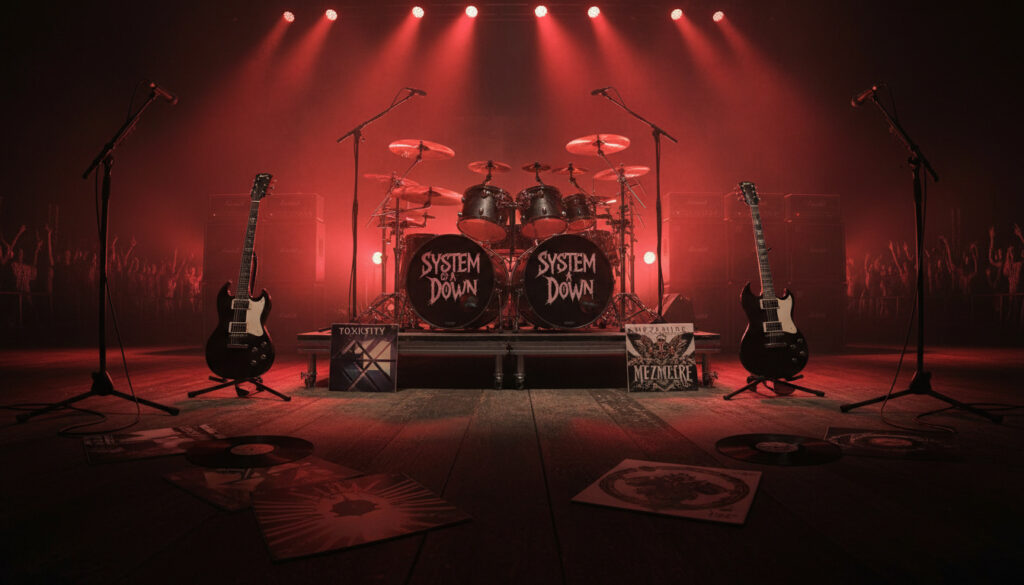
System of a Down – Members, History, Albums and 2025 Updates
System of a Down stands as one of the most politically vocal acts in heavy metal history. Formed in 1994 in Glendale, California, the Armenian-American quartet fused aggressive instrumentation with uncompromising social commentary, selling over 12 million records worldwide while maintaining an unconventional career trajectory that has seen extended hiatuses and sporadic reunions.
The band’s distinctive sound blends heavy metal and alternative rock with rapid structural shifts and Armenian-influenced melodic elements. Their lyrics consistently address war, genocide, and systemic injustice, earning them a Grammy Award in 2006 for “B.Y.O.B.” while cultivating a dedicated global following that spans multiple generations.
Who Are the Members of System of a Down?
The group comprises four musicians of Armenian descent whose shared cultural heritage fundamentally shapes their artistic output. Serj Tankian handles lead vocals and keyboards, Daron Malakian serves as guitarist and secondary vocalist, Shavo Odadjian plays bass guitar, and John Dolmayan occupies the drum kit.
1994, Glendale, California
Heavy metal / Alternative rock
4 core (stable since 1997)
Toxicity (2001)
- Shared Heritage: All core members trace Armenian ancestry, directly influencing the band’s thematic focus on the Armenian genocide and justice.
- Serj Tankian: Born August 21, 1967, in Beirut, Lebanon, providing lead vocals and keyboard arrangements since formation.
- Daron Malakian: Born July 18, 1975, in Los Angeles, California, contributing guitar work and vocal harmonies.
- Shavo Odadjian: Born April 22, 1974, in Armenia, initially serving as manager before assuming bass duties.
- John Dolmayan: Born July 15, 1973, in Lebanon, joining in 1997 to complete the stabilized lineup.
- Predecessor: Andy Khachaturian played drums from 1994–1997 before departing due to a hand injury.
- Name Origin: Derived from Malakian’s poem “Victims of a Down,” later modified for the band.
| Fact | Details |
|---|---|
| Origin | Glendale, California (1994) |
| Precursor Band | Soil (1994 lineup) |
| Genres | Heavy metal, alternative rock |
| Years Active | 1994–2006, 2010–present |
| Studio Albums | 5 |
| Total Sales | 12 million+ records |
| Grammy Awards | 1 win (“B.Y.O.B.”, 2006) |
| Record Label | American/Columbia (Rick Rubin) |
| Lead Vocalist | Serj Tankian |
| Current Drummer | John Dolmayan (since 1997) |
| Original Drummer | Andy Khachaturian (1994–1997) |
| Chart Achievement | 3 albums debuted at #1 on Billboard 200 |
What Genre Is System of a Down and Why Are They Famous?
Musically, the group occupies the intersection of heavy metal and alternative rock, distinguished by abrupt tempo changes, unconventional song structures, and the integration of Middle Eastern musical motifs. This sonic palette serves as the vehicle for their primary claim to fame: unflinching political commentary delivered through aggressive yet melodic compositions.
The band’s Armenian roots fundamentally inform their artistic identity. All four members descend from Armenian families, a shared background that manifests in recurring lyrical examinations of the Armenian genocide, systemic injustice, and anti-war sentiments. This cultural specificity distinguishes them within the broader heavy metal landscape, offering perspectives rarely addressed in mainstream rock music.
Their breakthrough arrived with the 2001 album Toxicity, which captured the cultural anxiety surrounding the September 11 attacks and the subsequent War on Terror. Tracks like “Chop Suey!” and “Toxicity” received extensive radio play despite—or perhaps because of—their jarring transitions and confrontational themes. The album’s commercial success, debuting at number one on the Billboard 200, established the band as a major commercial force capable of merging underground aggression with mainstream appeal.
When Did System of a Down Form and What’s Their History?
Formation and the Soil Era (1993–1994)
The genesis occurred in 1993 when Serj Tankian and Daron Malakian encountered each other in a Los Angeles recording studio while pursuing separate musical projects. This meeting precipitated the formation of Soil, featuring Tankian on vocals and keyboards, Malakian on guitar, and Ontronik Khachaturian on drums. Shavo Odadjian initially served as the group’s manager before transitioning to bass guitar after the departure of the original bassist.
Following Soil’s dissolution, the group sought a fresh identity. Malakian had written a poem titled “Victims of a Down,” which the band adapted to become System of a Down. This rebranding coincided with their recruitment of producer Rick Rubin, who signed the band to American Recordings after witnessing their performance at the Viper Room.
Rise to Prominence (1997–2005)
A pivotal personnel change occurred in 1997 when John Dolmayan replaced Andy Khachaturian on drums, solidifying the lineup that persists today. Their self-titled debut album arrived in 1998, introducing listeners to their caffeinated musical shifts and Tankian’s distinctive vocal delivery. However, the true commercial explosion came with Toxicity in 2001.
The Toxicity era proved culturally significant. The album addressed the prison industrial complex (“Prison Song”), drug addiction, and media manipulation while maintaining the aggressive sonic palette that defined their sound. In 2005, the group released a double album sequence: Mezmerize in May and Hypnotize in November, both debuting at number one on the Billboard 200. The single “B.Y.O.B.” (Bring Your Own Bombs) earned them a Grammy Award for Best Hard Rock Performance in 2006.
Hiatus and Reunion
Following the Mezmerize/Hypnotize cycle, the band entered an indefinite hiatus in 2006. Members pursued individual projects: Tankian released solo work exploring orchestral and electronic territories, while Malakian formed Scars on Broadway. The separation lasted four years, with the group reconvening in 2010 for festival appearances and touring. Despite performing regularly since the reunion, they released no full-length studio album for fifteen years until the 2020 singles “Protect the Land” and “Genocidal Humanoidz,” which addressed the Nagorno-Karabakh conflict.
What Are System of a Down’s Biggest Songs and Albums?
The discography consists of five studio albums, with three debuting at the top of the US Billboard 200. Their commercial peak occurred during the early 2000s, though their streaming numbers remain substantial decades later.
The 2001 album Toxicity remains their cultural landmark. Beyond its commercial performance, the record captured a specific historical moment, offering critique of systems of control and violence during a period of heightened national tension. Singles “Aerials” and “Hypnotize” both topped Billboard’s Alternative Songs chart, cementing the band’s radio presence.
- System of a Down (1998): Raw debut establishing their frantic energy and political stance.
- Toxicity (2001): Commercial breakthrough addressing prisons, war, and addiction.
- Steal This Album! (2002): Collection of material recorded during the Toxicity sessions.
- Mezmerize (2005): First half of the double album, featuring “B.Y.O.B.”
- Hypnotize (2005): Companion release completing the conceptual arc.
In 2020, the band broke their fifteen-year recording silence with two singles responding to the Armenian-Azerbaijani conflict over Nagorno-Karabakh. “Protect the Land” and “Genocidal Humanoidz” marked their first new studio material since 2005, released to support Armenia Fund and raise awareness of the violence.
System of a Down History Timeline
- 1993–1994: Tankian and Malakian form Soil in Los Angeles; Odadjian transitions from manager to bassist; band renames to System of a Down.
- 1997: John Dolmayan replaces Andy Khachaturian as drummer, stabilizing the classic lineup.
- 1998: Release of self-titled debut album through American Recordings.
- 2001: Toxicity released; debuts at #1 on Billboard 200; “Chop Suey!” becomes signature single.
- 2005: Dual release of Mezmerize (May) and Hypnotize (November); “B.Y.O.B.” wins Grammy.
- 2006: Band enters indefinite hiatus following touring cycle.
- 2010: Official reunion for live performances beginning with European festivals.
- 2020: Release of “Protect the Land” and “Genocidal Humanoidz” in response to Nagorno-Karabakh conflict.
- September 2025: Performance in Toronto with Deftones documented by attendees.
Is System of a Down Still Active in 2025?
Established Facts
- Reunited in 2010 and has performed regularly since
- Original four-piece lineup remains intact
- No official breakup announcement has ever been issued
- Performed live in Toronto in September 2025
- Released two new singles in 2020 after 15-year gap
Remaining Uncertainties
- No full-length studio album since 2005’s Hypnotize
- No confirmed comprehensive tour dates for 2025 beyond isolated appearances
- Internal tensions regarding musical direction persist among members
- Future recording plans remain unannounced
How Did System of a Down Change Heavy Metal?
The band’s influence extends beyond their discography into the broader cultural discourse of heavy metal. By incorporating specific historical trauma—the Armenian genocide—into mainstream metal, they expanded the genre’s thematic possibilities. Their musical approach, characterized by jarring dynamic shifts and non-linear song structures, challenged the verse-chorus-verse conventions dominating rock radio in the late 1990s. For those interested in the band’s lyrical content, you can find the Sekai No Owari サザンカ 歌詞 here.
While contemporaries like Ed Sheeran Sydney 2026 represent the streamlined pop trajectory of modern music consumption, System of a Down occupies a different space entirely: one where commercial success coexists with radical political messaging. Their ability to sell out arenas while performing songs critical of the prison industrial complex and military adventurism demonstrates a rare alignment of artistic integrity and popular appeal.
The band’s sporadic output has only amplified their mystique. Unlike acts that maintain relevance through constant production, their silence between 2006 and 2010, and again between 2020 and the present, has created a scarcity that keeps their existing catalog in constant rotation. This model—wherein political urgency trumps commercial scheduling—has influenced subsequent generations of metal and hardcore bands.
Documented Sources and References
Factual assertions regarding formation dates, personnel changes, and discography derive from verified music journalism archives and academic databases. Specific details regarding the 1994 formation in Glendale, California, and the transition from Soil to System of a Down appear in EBSCO Research Starters and Last.fm archives.
Documentation of the 1997 lineup stabilization with John Dolmayan, the 2006 hiatus, 2010 reunion, and 2020 single releases appears in Last.fm’s band biography. The 2025 Toronto performance observation derives from fan-documented footage and reports. Comprehensive discography information, including chart positions and Grammy recognition, appears in Wikipedia’s entry and AllMusic.
The Grammy Awards database confirms the 2006 win for “B.Y.O.B.” Additional historical context regarding the band’s Armenian-American identity and musical evolution appears in official band communications and documentary footage.
Why System of a Down Remains Essential
Three decades after their formation, the group persists as a singular entity in rock music—capable of filling stadiums without releasing an album in twenty years, maintaining political relevance while avoiding the pitfalls of nostalgia acts. Their catalog, particularly Toxicity and the Mezmerize/Hypnotize pairing, continues to attract new listeners through streaming platforms, introducing successive generations to their specific brand of socially conscious aggression. Like the enduring cultural footprint of the Modern Family Cast, their work has transcended its original moment to become part of broader popular culture vocabulary.
Frequently Asked Questions
Why did System of a Down go on hiatus in 2006?
The band entered hiatus following the touring cycle for Mezmerize and Hypnotize (2005) to pursue individual creative projects. Members worked on solo albums and side bands, returning to live performance in 2010.
What is the meaning behind the Toxicity album?
The 2001 album critiques the prison industrial complex, drug addiction, systemic violence, and media manipulation. Released shortly after 9/11, it captured cultural anxiety about war and social control.
Who was the original drummer for System of a Down?
Andy Khachaturian played drums from 1994 until 1997, leaving due to a hand injury. John Dolmayan replaced him, completing the lineup that remains active today.
Has System of a Down officially broken up?
No. Despite rumors fueled by their lack of new albums since 2005, the band has never announced a breakup. They reunited in 2010 and continue performing live, including a 2025 appearance in Toronto.
What was System of a Down’s original band name?
They originally performed as Soil in 1994. After that project dissolved, they adopted System of a Down, derived from Daron Malakian’s poem “Victims of a Down.”
When did System of a Down release new music last?
The band released two singles, “Protect the Land” and “Genocidal Humanoidz,” in 2020. These were their first studio recordings since Hypnotize in 2005, released in response to the Nagorno-Karabakh conflict.
More related posts
 Cali Beach Club: Entry Fees, Dress Code, Reviews & Guide
 Best Good Morning Greeting: Contexts & Examples
 482 Visa Processing Time 2026: Guide, Refusal & PR Pathway
 PS5 Big W: Consoles, Prices, Models, & Stock Guide
 Tatiana Schlossberg, JFK Granddaughter, Dies from AML at 35
 Johnny Manziel: From Heisman to NFL Bust and Life Now
 Alice in Chains: Biggest Hits, Tragic Deaths, and Band Legacy
 Eng vs Pak 2026 T20 World Cup: Result, Records & History
