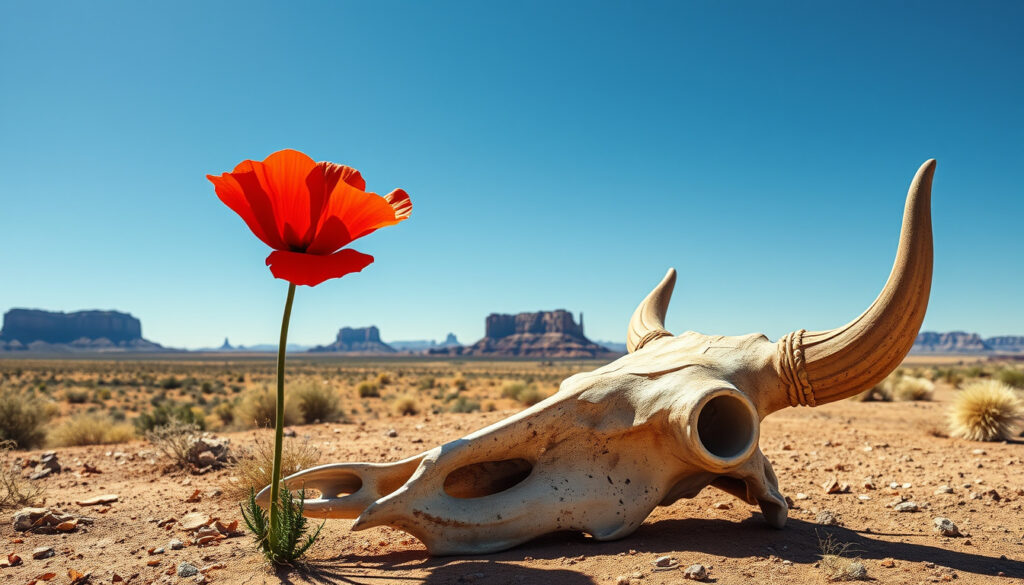
Georgia O’Keeffe: Life, Art, and Legacy of the American Modernist
There is a reason a flower painted nearly a century ago still stops you in your tracks: Georgia O’Keeffe didn’t just paint blossoms; she blew them up until they became landscapes of their own, forcing viewers to look at the familiar as if for the first time. In doing so, she carved out a singular place in American modernism that continues to shape how we think about scale, abstraction, and the art of seeing.
Born: November 15, 1887 ·
Died: March 6, 1986 ·
Known For: Modernist paintings, especially enlarged flowers ·
Most Famous Work: Jimson Weed/White Flower No. 1 (1932) ·
Record Sale: $44.4 million (2014) ·
Spouse: Alfred Stieglitz (married 1924–1946)
Quick snapshot
- Pioneering American modernist painter (Encyclopaedia Britannica)
- Famous for large-format flowers, bones, and New Mexico landscapes (Encyclopaedia Britannica)
- Married photographer Alfred Stieglitz in 1924 (Biography.com)
- Jimson Weed/White Flower No. 1 sold for $44.4 million in 2014 (Encyclopaedia Britannica)
- Exact nature of her eye condition beyond macular degeneration is not fully documented (Encyclopaedia Britannica)
- Whether her depression was clinically diagnosed or a biographical inference (Biography.com)
- Stieglitz’s direct influence on her style is still debated among scholars (PBS American Masters)
- 1887: Born in Wisconsin (Encyclopaedia Britannica)
- 1916: First show at Stieglitz’s 291 gallery (Biography.com)
- 1929: First summer in New Mexico (Encyclopaedia Britannica)
- 1986: Dies in Santa Fe at 98 (Encyclopaedia Britannica)
- O’Keeffe’s legacy continues to grow through the Georgia O’Keeffe Museum (Ghost Ranch)
- Her work is central to discussions of female artists and auction value (Encyclopaedia Britannica)
- New exhibitions regularly feature her New Mexico period (PBS Wisconsin Education)
Eight key facts anchor the life of an artist whose work still defines American modernism.
| Field | Value |
|---|---|
| Full Name | Georgia Totto O’Keeffe |
| Born | November 15, 1887, Sun Prairie, Wisconsin |
| Died | March 6, 1986, Santa Fe, New Mexico |
| Movement | American Modernism, Precisionism |
| Spouse | Alfred Stieglitz (m. 1924–1946) |
| Famous Works | Jimson Weed/White Flower No. 1, Blue and Green Music, Summer Days |
| Art Style | Close-up abstraction, bold colors, natural forms |
| Museum | Georgia O’Keeffe Museum, Santa Fe, NM |
What is Georgia O’Keeffe best known for?
Pioneer of American Modernism
- O’Keeffe is widely described as the “Mother of American modernism” (Encyclopaedia Britannica), a label that underscores her role in shaping a distinctly American visual language.
- Her work is characterized by a blend of realism and abstraction that turned everyday subjects into monumental forms.
She didn’t just participate in modernism; she helped define what it could look like when stripped of European influence. The pattern: O’Keeffe’s uniquely American vision—rooted in the shapes of the Southwest rather than Parisian ateliers—gave modernism a new geography.
Signature flower close-ups and abstraction
- Her paintings of enlarged flowers became one of the signatures of her career (Biography.com).
- She created close-up flower paintings that made ordinary floral forms appear abstract and monumental (PBS Wisconsin Education).
The catch: what many critics first read as decorative or feminine was, in fact, a radical re-scaling of perception—taking something small and forcing the viewer to confront it as a landscape.
Landscapes of the Southwest
- After 1929, she began spending part of each year in the Southwest, which strongly shaped her New Mexico imagery.
- She also painted New York skyscrapers and New Mexico landscapes (Biography.com).
- The New Mexico desert remained a major source of inspiration for the rest of her life after her move there (PBS Wisconsin Education).
O’Keeffe’s Southwest landscapes didn’t just record a place—they invented a visual vocabulary for the American desert that changed how the art world saw the region. Before her, the Southwest was ethnographic scenery; after her, it became a subject of modernist abstraction.
The implication: her ability to merge place with abstraction created a visual vocabulary that no American artist had attempted before.
What is Georgia O’Keeffe’s most famous artwork?
‘Jimson Weed/White Flower No. 1’ (1932)
- ‘Jimson Weed/White Flower No. 1’ sold for $44.4 million in 2014, a record for a female artist at the time (Encyclopaedia Britannica).
- The painting features a large, close-up view of a Jimson weed flower.
- It is housed in the Georgia O’Keeffe Museum in Santa Fe.
‘Blue and Green Music’ (1919–1921)
- This work exemplifies O’Keeffe’s synesthetic approach—translating musical rhythms into visual abstraction.
- It is held by the Art Institute of Chicago and is considered a landmark of early American abstraction.
‘Summer Days’ (1936)
- Painted after her move to New Mexico, this work layers a deer skull with flowers against a desert backdrop.
- It captures the surreal quality of the Southwest landscape that became her signature subject.
The implication: the $44.4 million sale wasn’t just a record—it was a market correction. For decades, O’Keeffe’s work was undervalued relative to male modernists; the 2014 auction signaled a long-overdue reassessment.
What was Georgia O’Keeffe’s famous quote?
‘I have things in my head that are not like what anyone has taught me.’
- O’Keeffe often spoke about following her own artistic vision.
- The quote reflects her rejection of conventional art training.
- She believed art should express inner experience, not replicate nature.
Quote about her creative independence
- In a 1920s interview, she framed her independence as a conscious choice against academic orthodoxy.
Other notable sayings
- “Nobody sees a flower really; it is so small. We haven’t time, and to see takes time.” This is perhaps her most famous line, explaining the rationale behind her enlarged flower works.
O’Keeffe’s most famous quote about flowers—”nobody sees a flower really”—is itself a contradiction: she made flowers so large that nobody could avoid seeing them. She solved her own complaint by creating the art that disproved it.
The pattern: her words and her work formed a self-correcting loop—she identified a problem with perception and painted the solution.
What did Georgia O’Keeffe suffer from?
Eye condition: macular degeneration
- O’Keeffe suffered from macular degeneration, which affected her vision in the 1970s.
- The diagnosis came in 1972, and her vision gradually deteriorated.
Depression and isolation in later years
- She also experienced bouts of depression, especially after Stieglitz’s death in 1946.
- The exact clinical nature of her depression remains unclear in the biographical record.
Impact on her late work
- Despite health issues, she continued to work, often with assistance.
- Her later pieces, completed with failing eyesight, show a shift toward simpler, more tactile forms.
The trade-off: O’Keeffe’s declining vision didn’t end her career—it transformed it. As her eyesight faded, her work moved from intricate detail to broader, more gestural forms, proving that physical limitation could become an artistic pivot rather than a full stop.
What are 5 facts about Georgia O’Keeffe?
Early life and education
- She was born in Sun Prairie, Wisconsin in 1887 (Encyclopaedia Britannica).
- She studied at the Art Institute of Chicago in 1905 (PBS American Masters).
- She studied at the Art Students League of New York in 1906 (PBS American Masters).
Relationship with Alfred Stieglitz
- She married photographer Alfred Stieglitz, who promoted her work, in 1924 (Biography.com).
- Stieglitz gave O’Keeffe her first gallery show in 1916 (Biography.com).
Move to New Mexico
- She settled in New Mexico in the 1940s and painted the region’s landscapes.
- Ghost Ranch and Abiquiú are strongly associated with O’Keeffe’s New Mexico life and work (Ghost Ranch).
Record-breaking auction
- Her painting ‘Jimson Weed/White Flower No. 1’ set an auction record for female artists in 2014 (Encyclopaedia Britannica).
Legacy and museum
- The Georgia O’Keeffe Museum in Santa Fe is dedicated to her life and work, opened in 1997.
- She received the Presidential Medal of Freedom in 1977 (PBS American Masters).
Timeline
Ten moments trace O’Keeffe’s arc from Wisconsin farm girl to the “Mother of American modernism.”
Clarity
Confirmed facts
- O’Keeffe was a pioneering American modernist painter. (Encyclopaedia Britannica)
- Her most famous work is ‘Jimson Weed/White Flower No. 1’. (Encyclopaedia Britannica)
- She married Alfred Stieglitz in 1924. (Biography.com)
- She suffered from macular degeneration later in life. (Encyclopaedia Britannica)
- She died in Santa Fe in 1986 at age 98. (Encyclopaedia Britannica)
What’s unclear
- The exact nature of her eye condition beyond macular degeneration is not fully documented. (Encyclopaedia Britannica)
- Whether her depression was clinically diagnosed or a matter of biographical inference. (Biography.com)
- The extent of Stieglitz’s direct influence on her style is debated among scholars. (PBS American Masters)
Key quotes
“I have things in my head that are not like what anyone has taught me.”
— Georgia O’Keeffe, on artistic independence
“Nobody sees a flower really; it is so small. We haven’t time, and to see takes time.”
— Georgia O’Keeffe, on flower paintings
“The first woman to create art that is truly feminine and yet universal.”
— Alfred Stieglitz, on O’Keeffe’s early work
For readers interested in the continuing legacy of modern painters, see how Ben Quilty: Biography, Art Style, Family, and Key Facts traces another artist’s journey through personal subject matter, or Sofia Coppola: Bio, Relationships, Movies & More for how a different creative figure navigates influence and authorship.
en.wikipedia.org, youtube.com, heni.com, facebook.com, artcuriouspodcast.com, georgiaokeeffe.net, okeeffemuseum.org
Frequently asked questions
Why did Georgia O’Keeffe paint flowers so large?
O’Keeffe enlarged flowers to force viewers to slow down and see details they would otherwise miss. She believed people didn’t take time to look at flowers closely.
Where can I see Georgia O’Keeffe’s paintings in person?
The Georgia O’Keeffe Museum in Santa Fe, New Mexico, holds the largest collection of her work. Major works are also at the Art Institute of Chicago, the Metropolitan Museum of Art, and the Museum of Modern Art in New York.
How did Georgia O’Keeffe influence modern art?
She pushed abstraction in American painting by scaling everyday subjects to monumental proportions, creating a visual language that combined realism with abstraction in a way no American artist had done before.
What materials did Georgia O’Keeffe use?
She primarily worked with oil on canvas. In her later years, when vision declined, she also worked with watercolor and pastel, and employed assistants to prepare canvases.
Did Georgia O’Keeffe have any students?
She taught briefly early in her career at schools in Texas and South Carolina, but she did not maintain a formal teaching studio or take on long-term apprentices.
How did her relationship with Alfred Stieglitz affect her career?
Stieglitz gave O’Keeffe her first exhibition in 1916 and promoted her work relentlessly. The relationship was both a professional accelerator and a personal anchor, though scholars debate whether it also constrained her public identity.
What is the Georgia O’Keeffe Museum address?
217 Johnson Street, Santa Fe, NM 87501, United States.
For the art world in the United States, the choice is clear: O’Keeffe’s market will likely continue to grow as museums and collectors reassess the contributions of female modernists, or the auction gap between her and her male peers will remain a stubborn artifact of historical bias.
More related posts
 Johnny Manziel: From Heisman to NFL Bust and Life Now
 Fish Sauce: What It Is, How to Use It, and Substitutes
 Spot the Difference – Free Online Games, Tips & Benefits
 Logue Brook Dam – Fatal Tubing Incident Facts and Safety
 Jemima Goldsmith: Biography, Marriages, and Net Worth
 Matty Johns: Brother Rift, Fox Salary, Wife & Kids Guide
 Dimebag Darrell’s Last Words and the Night He Died
 IKEA Chest of Drawers – Malm vs Hemnes Guide
